As an Amazon Associate, we earn from qualifying purchases. Some links on this site are affiliate links at no extra cost to you. Our recommendations are based on thorough research and editorial judgment.


5 Best Guitar Fretboard Radius Options That Shape Your Sound

Looking to nail that perfect fretboard radius for your guitar? You’ve got cool options like the Dreamtop 9-Pc Gauge Set, which slides easily under strings for fast checks, or the KAISH sanding block that shapes with precision—no fret left behind! The 15-Piece Luthier Set covers all sizes, plus Piutouyar and StewMac offer sturdy stainless steel tools built to last. Want comfy playability and killer tone? These choices have you covered! Keep going, and you’ll discover exactly what fits your style best!
Key Takeaways
- Stainless steel radius gauge sets ranging from 7.25″ to 20″ provide precise fretboard curvature measurement for improved playability.
- Foldable, compact radius tools enhance portability and protect the tool during transport while ensuring accurate string action checks.
- High-quality, rustproof materials ensure durability and maintain measurement accuracy over long-term guitar maintenance.
- Customizable sanding blocks like the KAISH 9.5″ radius block help with precise fret leveling and fretboard shaping.
- Choosing the correct radius gauge based on guitar style improves string bending ease, comfort, and overall tonal response.
| Dreamtop 9-Pc Guitar Radius & String Gauge Set | 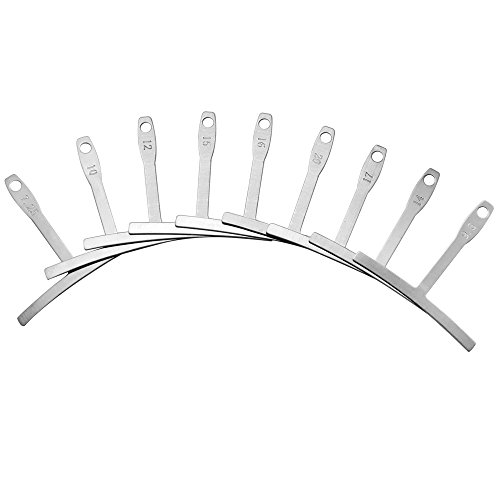 | Best for Versatility | Number of Radius Gauges: 9 gauges | Radius Sizes Included (in inches): 7.25, 9.5, 10, 12, 14, 15, 16, 17, 20 | Material: Stainless steel | VIEW LATEST PRICE | Read Our Analysis |
| KAISH Guitar Bass Fingerboard Sanding Block | 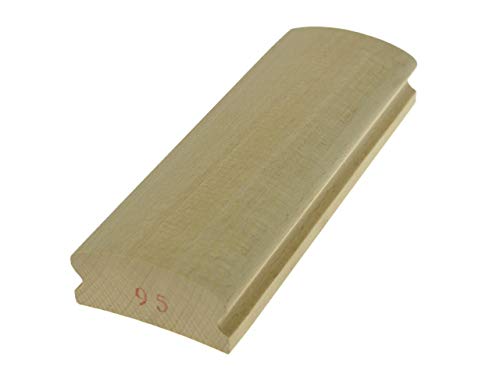 | Premium Wood Tool | Number of Radius Gauges: 1 radius (9.5 inch sanding block) | Radius Sizes Included (in inches): 9.5 (single sanding block) | Material: Beech wood | VIEW LATEST PRICE | Read Our Analysis |
| 15-Piece Guitar Luthier Tool Set | 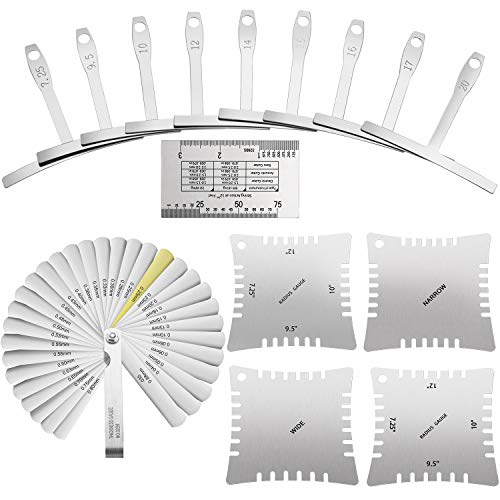 | Complete Setup Kit | Number of Radius Gauges: 9 gauges (including 4 notched radius gauges) | Radius Sizes Included (in inches): 7.25, 9.5, 10, 12, 14, 15, 16, 17, 20 | Material: Stainless steel (various tools) | VIEW LATEST PRICE | Read Our Analysis |
| Piutouyar 9-Piece Guitar String Radius Gauge | 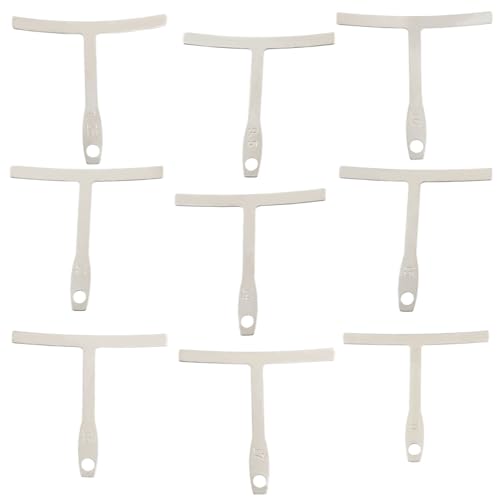 | Precision Rustproof | Number of Radius Gauges: 9 gauges | Radius Sizes Included (in inches): 7.25, 9.5, 10, 12, 14, 15, 16, 17, 20 | Material: Stainless steel | VIEW LATEST PRICE | Read Our Analysis |
| StewMac Understring Radius Gauge Set for Guitars |  | Lifetime Durability | Number of Radius Gauges: 9 gauges | Radius Sizes Included (in inches): 7.25, 9.5, 10, 12, 14, 15, 16, 17, 20 | Material: Not explicitly stated but implied durable metal (lifetime promise) | VIEW LATEST PRICE | Read Our Analysis |
You may be interested


More Details on Our Top Picks
Dreamtop 9-Pc Guitar Radius & String Gauge Set
If you want to keep your guitar sounding just right, the Dreamtop 9-Pc Guitar Radius & String Gauge Set is your new best friend! This set includes nine radius gauges—from 7.25 to 20—that measure your fretboard, saddle, and nut radius like a pro. Just slide the steel gauge under or over your strings and instantly see if your guitar’s curve matches the specs.
Made from smooth, rust-proof stainless steel, these little tools are tough and gentle—no scratches here! Compact and easy to carry, they’re perfect for quick check-ups. Ready to dial in perfect playability? This kit’s got your back!
- Number of Radius Gauges:9 gauges
- Radius Sizes Included (in inches):7.25, 9.5, 10, 12, 14, 15, 16, 17, 20
- Material:Stainless steel
- Intended Use for Measuring Guitar Radius:Fretboard, saddle, and nut radius measurement
- Portability / Size:Compact and easy to carry (5.2 x 3.23 x 0.35 inches)
- Rust/Corrosion Resistance:Anti-rust stainless steel
- Additional Feature:Measures above/below strings
- Additional Feature:Smooth edges prevent scratches
- Additional Feature:Popular fretboard radius gauges
KAISH Guitar Bass Fingerboard Sanding Block
The KAISH Guitar Bass Fingerboard Sanding Block is a dream tool for anyone who loves perfecting their guitar’s fretboard with precision! It’s made from sturdy beech wood and shaped with a 9.5-inch radius, just right for most guitars and basses. You’ll need to attach your own sandpaper, but that’s part of the fun—customizing your grit for the job at hand. Measuring 200mm long and 70mm wide, it fits perfectly in your hand for smooth, controlled sanding.
Why guess radius when you can trust a block designed to shape it? Ready to level those frets like a pro?
- Number of Radius Gauges:1 radius (9.5 inch sanding block)
- Radius Sizes Included (in inches):9.5 (single sanding block)
- Material:Beech wood
- Intended Use for Measuring Guitar Radius:Fingerboard radius sanding/block leveling
- Portability / Size:Medium size sanding block (5.31 x 3.39 x 0.67 inches)
- Rust/Corrosion Resistance:Wood (not applicable)
- Additional Feature:Made of Beech wood
- Additional Feature:Requires attachment of sandpaper
- Additional Feature:Designed for fret leveling
15-Piece Guitar Luthier Tool Set
Calling all guitar lovers who want to up their setup game—this 15-piece Guitar Luthier Tool Set has got your back! Imagine measuring your fretboard radius with nine sizes of radius gauges, from 7.25” to 20”. No more guessing! You also get a pocket-sized string action ruler with metric and imperial scales—perfect for checking your string height, saddle depth, and nut height.
Made of rustproof stainless steel with a chrome-plated feeler gauge, these tools last forever. Plus, the gauges stay parallel to the fingerboard, meaning you can measure curvature without removing strings. Ready to sound better? Let’s get setup!
- Number of Radius Gauges:9 gauges (including 4 notched radius gauges)
- Radius Sizes Included (in inches):7.25, 9.5, 10, 12, 14, 15, 16, 17, 20
- Material:Stainless steel (various tools)
- Intended Use for Measuring Guitar Radius:Fingerboard, saddle, nut, string action measurements
- Portability / Size:Pocket-sized tools
- Rust/Corrosion Resistance:Rustproof and corrosion-resistant stainless steel
- Additional Feature:Includes string action ruler
- Additional Feature:Foldable tempered steel feeler
- Additional Feature:Measures multiple guitar parameters
Piutouyar 9-Piece Guitar String Radius Gauge
Got a bunch of guitars or basses and need to keep their fretboard radius just right? The Piutouyar 9-Piece Guitar String Radius Gauge has got your back! This nifty tool features nine stainless steel gauges, covering from 7.25 to 20 inches. Want to check your fretboard curve above or below the strings? No problem!
It’s small, rust-resistant, and tough as nails—so no worries about dents or warping in your toolbox. Perfect for electric, acoustic, folk guitars, and basses! Think of it as your fretboard’s best friend, making maintenance and repairs way easier and spot-on. Ready to measure like a pro?
- Number of Radius Gauges:9 gauges
- Radius Sizes Included (in inches):7.25, 9.5, 10, 12, 14, 15, 16, 17, 20
- Material:Stainless steel
- Intended Use for Measuring Guitar Radius:Guitar and bass understring radius measurement
- Portability / Size:Small and lightweight
- Rust/Corrosion Resistance:Rust and corrosion resistant stainless steel
- Additional Feature:Small and lightweight design
- Additional Feature:Suitable for various guitar types
- Additional Feature:Resistant to deformation
StewMac Understring Radius Gauge Set for Guitars
If you want to nail your guitar’s setup with precision, StewMac’s Understring Radius Gauge Set is a game-changer! This set includes 9 radius gauges—from 7-1/4” to 20”—covering most 6-string guitars and 4-string basses. Wondering how it works? Place the gauge under your strings, then adjust saddle or polepiece height to match the fingerboard’s curve. Its low profile means you don’t even have to remove strings—easy peasy!
Pro tip: Use the gauge with strings on, and you’ll see why StewMac promises lifetime durability. Need help? Their expert support has your back! Ready to sound great?
- Number of Radius Gauges:9 gauges
- Radius Sizes Included (in inches):7.25, 9.5, 10, 12, 14, 15, 16, 17, 20
- Material:Not explicitly stated but implied durable metal (lifetime promise)
- Intended Use for Measuring Guitar Radius:String height matching for saddle/polepieces to fingerboard arc
- Portability / Size:Low profile for use with strings on; dimensions not specified
- Rust/Corrosion Resistance:Built to last a lifetime (implying corrosion resistance)
- Additional Feature:Fits string spreads to 2-5/8″
- Additional Feature:Low profile for use with strings on
- Additional Feature:Lifetime Promise for durability
Factors to Consider When Choosing Guitar Fretboard Radius

Choosing the right fretboard radius isn’t just about numbers—it affects how your guitar feels and plays! You’ll want to think about the size options, how accurate your measurements are, and the quality of the tools you use. Plus, don’t forget portability and whether your chosen gauge fits your specific instrument—your perfect radius is out there!
Radius Size Options
Picking the right fretboard radius can totally change how your guitar feels under your fingers! Think of radius size as the curve of a circle—measured in inches—used to shape the fretboard’s arc. Smaller radii, like 7.25 inches, curve more, making finger bends easier and chords comfy—great for blues or vintage vibes. Medium sizes (9.5 to 12 inches) offer a sweet spot, balancing smooth playing and chord comfort across styles. Want to shred fast? Bigger radius options, like 16 to 20 inches, flatten the fretboard, letting strings glide easily for speedy solos. Here’s a quick table:
| Radius (inches) | Feel | Best For |
|---|---|---|
| 7.25 | Curvy, bend-friendly | Vintage, chords |
| 9.5–12 | Balanced curve | Versatile playing |
| 16–20 | Flat, fast lead playing | Shredders |
Measurement Accuracy Importance
Because your fretboard radius shapes how your strings curve and feel under your fingers, measuring it accurately is a game-changer! Imagine trying to hit perfect chords with a fretboard that’s “close enough”—ouch, your fingers don’t want that.
Use radius gauges to get precise readings; they take the guesswork out and help you dial in string action comfortably. Different styles need different radii—jazz vs. metal players, anyone? Keep your gauge handy and check often to keep your setup spot-on.
Here’s a quick tip: place the gauge on your fretboard, and match it with the curve—boom! You’ve got your radius. Remember, consistent accuracy keeps your guitar responsive and your fingers happy. So, grab that radius gauge and treat your guitar right!
Material Quality Impact
While you might think all fretboard radius gauges are pretty much the same, the material they’re made from actually plays a huge role in how well they perform and how long they stick around for your guitar sessions! For example, high-quality stainless steel is a superstar here—it’s smooth, tough, and won’t scratch your fretboard. Plus, it resists rust, so your gauge won’t turn into a rusty relic.
Ever wonder why some tools feel sturdy while others seem flimsy? That’s all about material strength. If the gauge bends or warps, your measurements become off, messing with your sound. Wood gauges look cool but need extra care to avoid wear and tear.
Tool Portability Benefits
Now that you know how much the material matters, let’s talk about something that’ll make your life on the road way easier: portability! Imagine a tiny tool, like a radius gauge, that fits right in your gig bag. You won’t lug around heavy gear or lose time digging through bulky cases. Cool, right?
These tools are often made from tough stainless steel, so they last through all your travel adventures. Plus, their sleek design lets you measure your fretboard radius super fast—no string-removal drama!
Because they’re so compact, you’ll actually carry them everywhere, leading to better maintenance habits. More checks mean better sound. Who knew such a small gadget could make a big difference? Keep it handy, and your guitar will thank you!
Compatibility With Instruments
If you want your guitar to feel just right under your fingers, picking the right fretboard radius is a big deal! Think of the fretboard radius like the curve of a slide—too curved or too flat, and it just won’t groove with your style. Jazz and vintage guitars usually sport smaller radii, like 7.25 or 9.5 inches, great for smooth chord work. Modern electrics? They lean toward larger radii, 12 or even 16 inches, perfect for fast solos. Use a radius gauge set to check your guitar’s curve—it’s like a measuring tape for curves! Remember, basses and acoustics may need different sizes, so keeping track can save you headaches later. Ready to make your guitar’s neck feel like home?
Durability and Warranty
Since you want your fretboard radius tool to stick with you through countless jam sessions, durability matters big time! Choose one made from high-quality stainless steel—it resists rust and keeps on working no matter how sweaty your hands get. Smooth edges? Absolutely! They prevent scratches on your guitar and make the tool last longer.
Look for a warranty too. It’s like a safety net, showing the maker believes in their product’s lifespan. Got a foldable or compact design? Bonus! It protects your tool during transport, saving it from accidental drops.
And hey, don’t forget to peek at customer ratings—they often tell real stories about toughness. Want your fretboard radius tool to be a lifelong bandmate? These tips have got you covered!
Frequently Asked Questions
How Does Fretboard Radius Affect Playing Comfort for Beginners?
Playing on a fretboard radius is like hugging a mini hill—curved just enough to fit your fingers! A smaller radius (rounder) feels comfy for chord grips, preventing finger cramps. Got a flatter radius? It’s great for bending notes without buzzing. As a beginner, pick a radius that feels natural; test different guitars if you can. Remember: comfort boosts practice time, so your fingers will thank you later!
Can Fretboard Radius Impact Guitar Tuning Stability?
Yes, fretboard radius can impact tuning stability! A flatter radius means less string bending, so your guitar stays in tune better when you play wild solos. On the flip side, curved fretboards make string bends easier but might cause slight tuning shifts. Think of it like this: less bend = more stable tuning! So, which one suits your style? Choose your radius wisely, and your guitar will thank you—and so will your audience!
Is Fretboard Radius Related to the Guitar’s Overall Tone Quality?
Yes, fretboard radius does affect your guitar’s tone, but not like changing strings or pickups would! A flatter radius lets you bend strings more smoothly, giving you that wailing blues vibe. A rounder radius favors chording and crisp notes—perfect for rhythm playing. Think of it like choosing shoes: flats for comfort, heels for style. So, pick your radius to match how you want to groove and sound!
How Often Should Fretboard Radius Be Measured or Adjusted?
You don’t need to measure your fretboard radius super often—once or twice a year is usually enough unless you gig hard or notice playability issues. Quick check? Use a radius gauge or a simple curve template! If strings buzz or bending feels funky, it might be time to adjust. Remember, too much fiddling can harm your sound. Like tuning, keep it regular but chill—it’s not rocket science!
Are Certain Fretboard Radii Better for Specific Music Genres?
If you play blues or rock, a rounder fretboard radius (9.5” to 12”) feels comfy for bends and vibrato. Jazz players might love a flatter radius (like 16”) for smooth chord shifts. Think of radius like shoe size—it affects your fit and style. Want to shred fast? Flatter radius helps with speedy solos! Check this quick table to match radius with genre:
| Genre | Radius (inches) |
|---|---|
| Blues | 9.5 – 12 |
| Rock | 10 – 12 |
| Jazz | 14 – 16 |
| Metal | 12 – 16 |


