As an Amazon Associate, we earn from qualifying purchases. Some links on this site are affiliate links at no extra cost to you. Our recommendations are based on thorough research and editorial judgment.


How to Read Sheet Music Faster as a Beginner Pianist

Are you a beginner pianist eager to read sheet music faster? You’ve come to the right place! In this guide, we’ll explore practical strategies that will help you master reading sheet music with confidence.
You may be interested
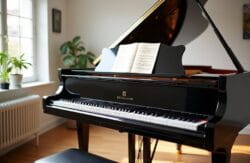


First things first, it’s essential to familiarize yourself with the fundamentals, such as the treble and bass clefs. With catchy mnemonics like EGBDF and FACE, remembering notes can become a breeze!
We’ll also discuss the importance of regular sight-reading practice and how it closely resembles a workout that improves over time. By breaking down challenging sections and focusing on patterns, you’ll soon find that reading music becomes easier and more enjoyable.
Stay patient, as every skilled pianist was once a beginner too!
Key Takeaways
- Practice sight-reading regularly by starting with easier pieces to build confidence and improve speed over time.
- Implement a landmarking system to quickly recognize reference notes like middle C on the staff.
- Break down difficult sections of music into smaller parts for manageable practice sessions and easier navigation.
- Focus on looking ahead while playing to maintain the flow and manage complexity in your reading.
- Use technology and interactive software to make learning sheet music engaging and enhance motivation through games and exercises.
Why Learn How to Read Sheet Music?

Hey! You know, learning to read sheet music really opens up a whole new world for anyone interested in music. If you’re thinking about becoming a musician, mastering this skill is so important! It not only helps you communicate better with other musicians—like when you’re jamming with friends—but it allows you to pick up just about any piece of music and start playing with confidence.
Picture this: You’re sitting at a piano, flipping through a collection of songs. When you can read the sheet music, it’s like having a map that lets you navigate through countless pieces effortlessly. You’re not just memorizing one song; you’re tapping into a treasure trove of music that’s waiting for you to explore.
Plus, being able to read sheet music means you can keep songs true to how the original artists intended. This is especially important if you ever want to perform someone else’s work or collaborate with other musicians. For instance, if a guitarist and a singer are working on a song together, being able to read the same sheet music keeps everyone on the same page—literally!
Additionally, using structured lesson plans can significantly enhance your ability to read sheet music faster by building skills step-by-step.
The Basics of Sheet Music

Hey there! Let’s chat about sheet music, which is pretty much like a secret code waiting for us to crack it. At the heart of it, you’ve got two main staffs: the treble clef at the top and the bass clef just below it. Each of these staffs has five lines and four spaces where notes hang out.
Do you recall the mnemonics we use to remember the lines and spaces? For the treble clef, just think EGBDF for the lines and the word FACE for the spaces. For the bass clef, it’s GBDFA for the lines and ACEG for the spaces. It’s like having a cheat sheet right in your pocket!
Now, let’s talk about Middle C. This note is a little bridge that connects both clefs, and it’s super helpful to know it as a reference point when you’re reading music. Once you’ve got that down, it’ll make navigating the staff a lot easier.
And don’t forget about the different types of notes. Whole notes, half notes, and quarter notes tell us how long to play each sound. For example, a whole note gets four beats, while a quarter note only gets one. You can really hear the difference when you play or clap them out!
Finally, we have time signatures, which set the rhythm for the piece. They tell us how many beats are in each measure and which note value gets the beat. Isn’t that cool? Understanding these basics makes reading sheet music feel more friendly and approachable. Ready to tackle some music pieces with this knowledge? Let’s move to the next step together!
Using tools like a preamp with an anti-feedback system can greatly enhance live music performances by making sound clearer and easier to manage.
How Sheet Music Corresponds to the Piano Keys

Hey there! I know that understanding how sheet music corresponds to the piano keys can feel a bit overwhelming at first, but trust me, it’s like an exciting musical treasure hunt! When you look at sheet music, you’ll notice it uses two different staffs: the treble clef that shows the higher notes and the bass clef for the lower ones, with Middle C acting as a bridge between the two.
Think of it this way: each note you see on that sheet music corresponds directly to a specific key on your piano! For the treble clef, remember the phrase “Every Good Boy Deserves Fudge” for the lines. And for the spaces, it’s as simple as “FACE.” Now, when you jump to the bass clef, you can use “Good Boys Deserve Fudge Always” for the lines and “All Cows Eat Grass” for the spaces. It might sound quirky, but these mnemonics really help in remembering which notes are which!
Also, don’t forget that notes have rhythms too. Those little circles and stems you see on the sheet music? They give you clues about how long to hold each note. Keep practicing, and before long, you’ll see how all these pieces fit together, turning that sheet music into beautiful music on the piano! Want to explore how to practice effectively next?
For even better progress, combining these basics with structured lessons and visual aids can dramatically enhance your learning experience.
Treble Clef Mnemonics
Hey there! So, let’s talk about the treble clef, which you might also hear called the G clef. It’s a pretty cool symbol that swirls around the G line, really highlighting the note G. Once you get comfortable with it, playing the piano becomes so much easier!
Now, when it comes to the lines of the treble clef, there’s this handy little mnemonic: “Every Good Boy Deserves Fudge.” It’s a fun way to remember that E, G, B, D, and F are sitting on those lines. For example, if you see a note sitting on the second line up, you instantly know it’s G!
Don’t overlook the spaces, either! They make it even easier because together they spell out “FACE,” representing F, A, C, and E. Isn’t that neat? Remembering such simple phrases can really speed up how you read sheet music and play those notes smoothly on the piano.
Once you’ve grasped these mnemonics, you can start picking up songs faster, and trust me, you’ll feel so accomplished. Alright, ready to explore some rhythm basics next? Using color-coded keyboard stickers can further enhance your note recognition and make learning visually engaging.
Bass Clef Mnemonics
Hey there! Have you ever wondered about the bass clef? It’s a fascinating part of music, and it’s also known as the F clef because it designates the note F on the second line of the staff. Isn’t that neat?
To help you read those notes more easily, there are some handy mnemonics. For the spaces in the bass clef, think of “All Cows Eat Grass.” Each word stands for a different note: A, C, E, and G. It’s a simple phrase that makes it easier to remember those notes when you see them on the staff.
Now, let’s talk about the line notes. You can use “Good Boys Deserve Fudge Always” to keep track of G, B, D, F, and A. It’s a fun little saying that sticks in your mind, making it easier to glance at the staff and play those notes confidently.
Don’t forget, practice is key! The more you work with these mnemonics, the more fluent you’ll become in reading the bass clef. Try writing them out or saying them aloud as you practice. As you get comfortable, you’ll find that understanding music becomes a whole lot easier. Ready to explore more about music notation?
Also, maintaining a proper humidity level around your piano is crucial to preserving your instrument as you learn to read and play new music.
How Notes Show Rhythm
Hey there! Let’s chat about rhythm in music—it’s like the heartbeat that gets you tapping your feet and moving along with the beat. To really get the hang of reading sheet music, we need to understand how notes show rhythm.
So, each type of note has a specific length that tells us how long to hold the sound. For instance, a whole note is simply an empty bubble and lasts for four beats, while a half note has a stem and lasts for two beats. Then you’ve got the quarter note, which looks like a filled bubble with a stem, and is quick, only lingering for one beat. Pretty straightforward, right?
Now, the tempo sets the scene for how fast or slow we play those notes. Imagine trying to run a race on flat tires—it’d feel heavy and sluggish, right? That’s exactly what can happen if you don’t keep track of the tempo while playing.
Also, getting familiar with time signatures is crucial. They help you maintain the right rhythm for each measure. For example, a 4/4 time signature means you have four beats in a measure. So, the next time you’re tapping along to a song, see if you can pick out those quarter notes! It’s all about feeling that rhythm and getting into the groove. Ready to take that understanding further? Let’s explore how dynamics can add even more texture to your music!
Using a digital piano with adjustable touch sensitivity can help you practice expressing different rhythms more effectively.
Note Lengths
Hey! Let’s talk about note lengths—they’re super important in music, especially when you’re learning to play the piano. Basically, note lengths determine how long you hold each note, shaping the way a song feels and flows.
Start with the whole note. It’s like a big, round bubble that gets four beats all to itself—pretty spacious, right? Then there’s the half note, which has a stem and holds two beats. Think of it as the whole note’s younger sibling who still gets a good chunk of time!
Next up is the quarter note, which takes just one beat. Picture it like a filled bubble that moves quickly; it’s really common in many pieces of music. When you’re playing, imagine a piece with a lot of quarter notes—it can create a lively rhythm!
Understanding these different note lengths helps you grasp the rhythm of a song, especially when you consider tempo. If you tried to rush through a whole note, it wouldn’t sound right at all! These basics are what’ll get you reading music more confidently and playing those tempos perfectly.
Using a piano pedal with your keyboard can enhance your expression significantly, making it easier to convey emotion through music with a universal sustain pedal.
Techniques for Faster Music Reading
You know what’s really exciting? Learning to read music faster feels like having a secret key to a whole new world of creativity. One great tip to boost your sight-reading speed is to use a landmarking system. When you recognize reference notes quickly, like middle C or the F on the bass clef staff, you can jump right into the music without getting bogged down.
Another important thing is to practice sight-reading regularly. Start with easier pieces—think simple folk songs or children’s melodies—before moving up to more complex compositions. It’s like training for a race; you build endurance little by little. And if you’re into games, there are plenty of online tools that can help you sharpen your note recognition. They turn practice into something fun that you’ll actually look forward to!
Don’t forget about using the aggregation method, too! This means recognizing patterns in the music, just like picking out common phrases in a new language. For example, if you see a sequence of notes that repeats, your eyes will start to catch onto it more naturally, making it easier to read as you go along.
Lastly, try to focus on looking ahead while you play. This keeps the music flowing and helps you manage multiple staves, especially in more complex pieces. It’s like trying to see what’s coming on the road ahead while driving instead of just looking at the hood. Let’s explore more tips that can help bring your music-playing skills to the next level!
Also, pairing your reading practice with a durable and responsive sustain pedal can enhance your playing experience by giving you better control over the sound’s resonance as you sight-read and perform.
Overcoming Challenges in Music Reading
Reading music can sometimes feel like you’re running a marathon, especially when you’re just starting out. Many beginners find themselves tripping up, particularly when they glance away from the score to check their hands. To make sight-reading smoother, it’s really helpful to minimize those eye movements. For instance, try practicing by looking at the sheet music for longer stretches without peeking at the keyboard.
Keeping an eye on bar-lines and system numbers can give you a little boost in confidence as you move through both the treble clef and bass. It’s like having a roadmap; knowing where you’re headed helps you stay in the zone.
But here’s a little tip: frequent hand shifts can throw a wrench in your flow! It often helps to establish fingerings in advance and visualize your hand movements. Picture your fingers moving to the next notes before you play them.
As you progress into more advanced pieces, those challenges can really start to ramp up! But don’t worry; structured practice with simpler pieces can make a world of difference. For example, using the landmarking technique—where you identify specific notes on the staff as reference points—can really help your music-reading skills improve. So as you face these hurdles, remember that you’ve got the tools to tackle them! What’s next on the agenda? Let’s explore some practice strategies to keep you moving forward!
In addition, understanding how sound control features influence tonal clarity can deepen your musical insight and improve your overall performance.
Efficient Learning Techniques
Hey there! If you’ve ever struggled with reading sheet music, let me share some efficient music learning tips that can really change the game for you. Starting with lead sheets is a great way to ease into things. They highlight the melody and include chord symbols, which makes it super easy to spot patterns. It’s like having a road map while you’re driving!
Now, when you face those tricky parts, try chunking them down into smaller, more manageable bits. Think of it as breaking a jigsaw puzzle into individual pieces—it just feels less overwhelming that way. And here’s a neat trick: use a pencil to write down fingerings directly on the music. That way, your fingers will know exactly where to go without second-guessing.
Don’t forget to keep your practice sessions short and frequent. Working on simpler pieces boosts your confidence and gets your fingers in shape. Once you’re comfortable, you can gradually tackle more complex pieces. Plus, practicing chord progressions will really sharpen your reading skills and help you improvise with ease. With these techniques, you’ll find that reading music is more approachable than you ever thought! Now, let’s talk about how you can enjoy this process even more with some fun practice ideas!
Also, maintaining your instrument with regular piano jack spring replacements ensures a smoother playing experience, making reading and playing sheet music easier and more enjoyable.
Mastering Chords for Improved Reading
Hey there! Did you know that mastering chords can completely change how you read sheet music? When you really get familiar with these building blocks of music, you start spotting notes much faster, and it makes playing pieces more enjoyable. For example, understanding common chord progressions like I-IV-V feels like having a shortcut to make sense of a song!
And here’s something cool: knowing how chords work can seriously boost your improvisation skills. Once you grasp the concepts of tension and resolution, you’re better prepared for those surprising shifts in music. It’s as if you can predict what’s coming next, making sight-reading feel like a breeze.
Make it a habit to practice different chord voicings and inversions. These techniques help you understand harmonies more clearly, which in turn makes tackling those tricky pieces much less scary. So, why not spend some time today just jamming with chords? It’ll make your musical journey so much richer! And speaking of journeys, let’s talk about how to apply these skills to your next favorite song. 🎶
Comprehensive Learning Approach
If you’re looking to become successful at reading sheet music, starting with a well-rounded approach is key! Think of mastering chords as the first stepping stone. Once you get comfortable with them, it becomes much easier to read music quickly and smoothly.
Have you ever tried connecting those chords to improvisation? It’s a great way to boost your creativity and enhance your sight-reading skills at the same time! For example, if you take a basic C major chord and add some simple melodies over it, you’ll start to feel more confident with what you’re playing.
As you progress and tackle more complex pieces, recognizing musical patterns will feel natural. It’s like having a map in your mind that guides your fingers. Regularly practicing simpler tunes builds that all-important confidence, preparing you for tougher songs down the line.
And don’t shy away from using interactive software or graded pieces. They can turn learning into a fun experience and cater to various skill levels. So, as you embark on this musical journey, remember: each note you master is a step closer to making those notes really come alive!
Frequently Asked Questions
How Long Does It Take to Read Piano Sheet Music?
Q: How long does it typically take to read piano sheet music?
A: The time needed to read piano sheet music can range from weeks to months. This depends on individual practice consistency and learning aptitude.
*Tip: Regular practice, even in short sessions, can significantly expedite your progress.*
Q: What factors influence proficiency in reading music?
A: Factors like prior musical experience, familiarity with note recognition, and understanding of rhythmic patterns play a role in achieving proficiency. Everyone learns at their own pace, so comparing yourself to others may not be helpful.
*Caveat: It’s essential to focus on your own improvement and set realistic goals for yourself.*
Q: How can I improve my music reading speed?
A: Consistent practice is crucial for enhancing reading speed and fluency in music. Incorporating sight-reading exercises can also be beneficial as they help with quick note recognition.
*Tip: Try increasing the difficulty gradually to challenge yourself and improve faster.*
How to Sight Read Faster on Piano?
Q: How can I sight read faster on piano?
A: To improve your sight reading speed, practice regularly with designated sight-reading materials. This consistent exposure helps build familiarity and fluency. Tip: Set a timer for each practice session to encourage focused efforts and track your progress.
Q: What is landmarking and how does it help?
A: Landmarking is identifying key notes and intervals on the staff to navigate music quickly. This technique allows you to recognize familiar patterns, helping to speed up your reading. Caveat: While landmarking is useful, don’t rely solely on it; be sure to practice reading unfamiliar pieces as well.
Q: Why is looking ahead while playing important?
A: Looking ahead allows you to anticipate upcoming notes or changes in the music, reducing pauses and interruptions in your playing. This skill helps maintain a smooth, continuous flow. Tip: Try to play a few measures ahead of where you are currently; practice this tactic gradually to develop your confidence.
Q: How can interactive games improve my sight reading speed?
A: Engaging in interactive games designed for music reading can enhance your note recognition speed through enjoyable practice. These games often provide instant feedback, making learning more effective. Caveat: Balance game time with traditional practice to ensure comprehensive skill development.
Is 1 Hour of Piano a Day Enough?
Q: Is one hour of daily piano practice enough for beginners?
A: Yes, one hour of daily practice is generally sufficient for beginners. This consistent engagement helps enhance skill development and reinforces techniques.
Tip: Focus on quality over quantity; ensure that your practice includes a variety of exercises, such as scales, pieces, and sight-reading.
Q: How does daily practice affect music reading abilities?
A: Daily practice contributes significantly to effective music reading skills over time. Regular engagement helps beginners become more familiar with musical notations and rhythms.
Caveat: Be patient; progress may not be immediate, and it’s essential to balance practice with theoretical study to bolster your understanding of music as a whole.
How to Read Sheet Music as a Beginner?
Q: What are staff lines in sheet music?
A: Staff lines are the five horizontal lines on which music notes are placed. Each line and space represents a different musical pitch.
*Tip: Familiarize yourself with the lines and spaces using mnemonic devices, like “Every Good Boy Does Fine” for the lines.*
Q: What are note values in sheet music?
A: Note values indicate the duration that a note should be held during a performance. Common note values include whole notes, half notes, quarter notes, and eighth notes.
*Caveat: Be careful with the timing; experiment clapping the different note values to grasp their duration better.*
Q: How do rhythm patterns work in sheet music?
A: Rhythm patterns organize the timing of notes and silences in music, creating a structured flow. Each measure typically contains a set number of beats, determined by the time signature.
*Tip: Practice counting out loud while playing to internalize rhythm and improve your timing.*
Q: What are key signatures in sheet music?
A: Key signatures are indicated at the beginning of a piece and show which notes are sharp or flat throughout the music, helping to establish its tonality. They appear on the staff before the time signature.
*Caveat: Don’t get discouraged by unfamiliar key signatures; spend time reviewing and learning them one at a time.*


