As an Amazon Associate, we earn from qualifying purchases. Some links on this site are affiliate links at no extra cost to you. Our recommendations are based on thorough research and editorial judgment.


What Are Seventh Chords and When to Use Them

Unlock the captivating world of seventh chords—exciting four-note harmonies that can transform your music!
You may be interested



Whether you’re a budding musician or an experienced songwriter, understanding how to use seventh chords will add depth and emotion to your compositions. These chords consist of a root, third, fifth, and seventh, offering a rich palette of sounds.
Major seventh chords evoke dreaminess (like Cmaj7: C, E, G, B), while dominant seventh chords deliver an edgy punch (like C7: C, E, G, B♭). Perfect for genres like jazz, blues, and pop, seventh chords enhance solos and melodies alike.
Ready to elevate your music? Let’s dive in and discover how to effectively incorporate these enchanting harmonies into your sound!
Key Takeaways
- Seventh chords are four-note chords that add depth and emotional richness to music, including major, minor, dominant, and diminished types.
- They are commonly used in genres like jazz, blues, and classical music to create tension, drama, and smooth transitions.
- Major seventh chords (e.g., Cmaj7) provide a lush, dreamy sound, making them perfect for jazz and pop compositions.
- Dominant seventh chords create a tension that typically resolves to tonic chords, often found in blues and jazz for excitement.
- Diminished and half-diminished seventh chords are effective for building dramatic tension, enhancing expressiveness in melodies and solos.
Definition of Seventh Chords

Have you ever listened to a melody and thought, “Wow, that chord just warms my heart!”? That could be a major seventh chord at work! Seventh chords are built from a basic triad, which consists of three notes, and then we add a fourth note that creates a seventh interval above the root note.
There are different flavors of seventh chords to explore. For example, a major seventh chord has a rich, lush sound that can really fill out a harmony, while a dominant seventh chord adds a bit of tension that keeps listeners intrigued. Imagine a classic blues song; that’s often where you’ll hear those dominant sevenths creating that signature gritty feel.
Choosing the right guitar, such as one with steel strings known for brightness and clarity, can enhance the tonal qualities of seventh chords in your playing.
Types of Seventh Chords
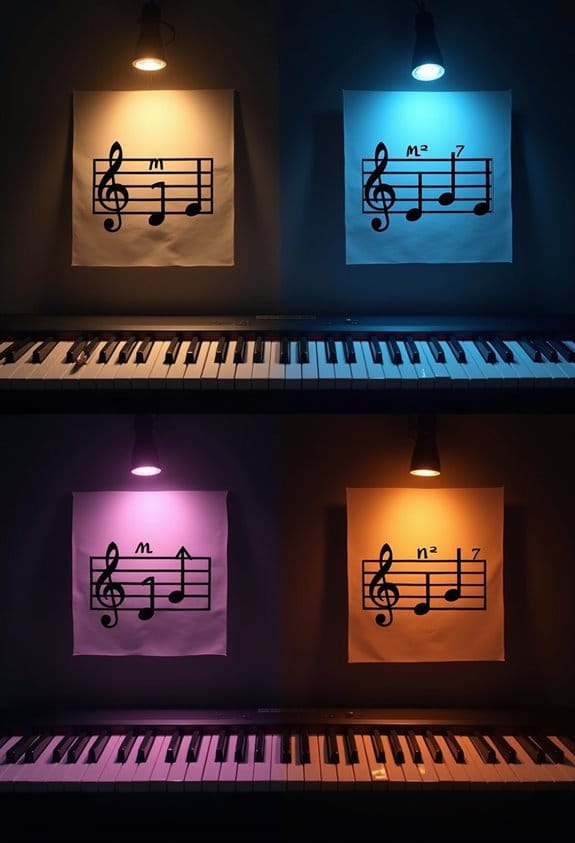
Seventh chords are such a fun way to add depth to your music! There are several types, and each has its own unique character that really enhances the sound. For instance, a major seventh chord combines a major triad with a major seventh interval. Think of it as adding a luxurious touch to your melody—popular in jazz and R&B, it creates a rich “maj7” vibe that’s just delightful!
On the flip side, the minor seventh chord has its own charm. By combining a minor triad with a minor seventh, you get that warm, inviting sound, often referred to as “m7.” It’s a great choice when you want to evoke a sense of comfort or nostalgia in your music, perfect for that cozy evening vibe!
Then there’s the half-diminished seventh chord, which mixes a diminished triad with a minor seventh. Notated as “ø7,” this chord has a certain tension that builds suspense in your music. You’ll hear it often in film scores when things get dramatic—basically, it’s the musical equivalent of holding your breath!
With all these variations, each seventh chord adds its own spice to the musical mix. So, which one are you eager to experiment with in your next composition? Knowing how to select and use string types and benefits can further enhance the expression of your seventh chords.
Recommended Products

PERFECT FOR BEGINNERS & INTERMEDIATE PLAYERS — Stop flipping through books during practice. This 11"x17" poster gives new guitar players exactly what they need to get started — 21 of the most used and easiest-to-play Major, Minor, and 7th chords, all on one easy-to-read chart. Unlike cluttered posters with dozens of chords you'll never use, this one keeps it focused so you can start playing real songs faster.
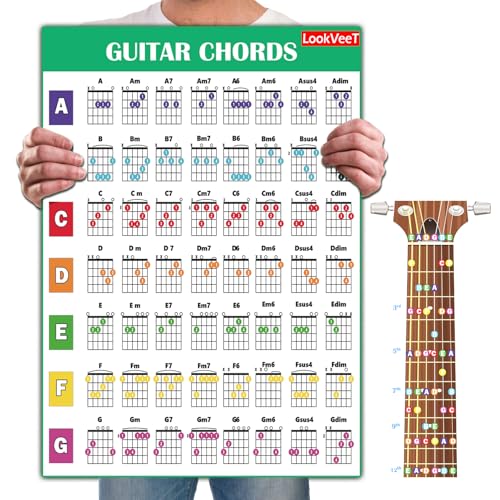
DUAL PACK VALUE: Includes both a comprehensive guitar chord chart poster and a portable a4 laminated chords for complete music theory learning

Master The Guitar - Get up to speed quickly and be able to jam instantly with Walrus Production's Guitar Posters for Walls! This guitar cords chart includes all of the essentials; A, B, C, D, E, F and G as well as the 3 Principle Chords, Minor Chords and Additional Chords.
Major Seventh Chords

Hey there! Let’s talk about major seventh chords. They’re such vibrant additions to music, combining a major triad with a major seventh interval. For example, Cmaj7 consists of the notes C, E, G, and B. Doesn’t that sound lovely? It’s like adding a splash of sunshine to your favorite song!
You’ll often find these chords in jazz, pop, and classical music because they create that dreamy, sophisticated feel. You might see them notated as “Maj7” or “Δ7,” indicating their major character. If you’ve ever felt a song wrap around you like a warm hug, chances are there was a major seventh chord at play.
Why not experiment with one in your own music? Try playing a major seventh chord progression, like moving from Cmaj7 to Dm7. You might be surprised at how it elevates your composition! It’s a simple trick that opens up new emotional depths in your melodies. Speaking of which, let’s explore more chord types and how they can transform your sound!
Using visual learning tools such as colorful keyboard stickers can help you quickly identify and practice these chords on your piano.
Recommended Products
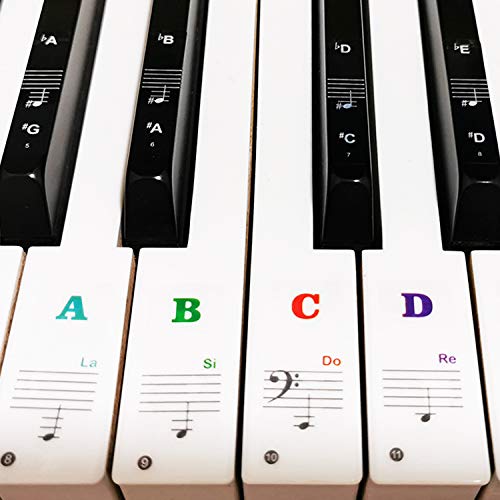
🎹 Size: Suitable for all 88/61/54/49/37 key pianos and keyboards. White key sticker 4.0cmX1.55cm(1.57”X0.61”). Black key sticker 3.9cmX0.85cm(1.54”X0.33”).

✔MULTIPURPOSE: This package contains 1 set of piano notes stickers, and colorful piano chord chart poster A4 size, use it as a memo while practicing to accelerate muscle memory,great piano gifts for learn to play piano.

✔MULTIPURPOSE: This package contains 1 set of piano notes stickers, and colorful piano chord chart poster A4 size, use it as a memo while practicing to accelerate muscle memory,great piano gifts for learn to play piano.
Dominant Seventh Chords
Hey there! Have you ever heard of dominant seventh chords? They’re like the secret ingredient that spices up your favorite dish, bringing a unique energy to music. Basically, a dominant seventh chord consists of a major triad (that’s three notes) combined with a minor seventh. For example, if you take a C dominant seventh chord, it includes C, E, G, and B♭. Can you sense how it adds a bit of tension?
Now, these chords usually show up on the fifth degree of the scale, and they have this compelling way of pulling towards the tonic chord. It’s like music’s way of saying, “I’m ready to resolve this!” This feeling is especially strong in genres like blues and jazz, where you’ll hear them used frequently to create excitement.
Let’s say you’re playing a blues piece; if you slap that dominant seventh chord in there, it really brings the whole piece to life. Imagine the thrill when it finally resolves into a beautiful tonic chord—it’s just satisfying! So, if you want to elevate your music, experimenting with dominant seventh chords could be the way to go. What do you think? Ready to give it a try? Using a velocity-sensitive MIDI controller can help you experiment with these chords expressively in your music production.
Recommended Products

Pro Production from the Get-Go - Portable USB MIDI keyboard controller for Windows and Mac laptops with a compact design and 32 miniature piano-style velocity-sensitive keys for a true piano feel

Ultimate Expression - 49 full-size velocity-sensitive keys provide a natural feel that captures every subtle nuance of your performance

Next-Gen Music Production and Beat Maker Essential - USB-powered MIDI keyboard controller with 25 mini velocity-sensitive keys, optimized for studio or beat production, piano-style performance, synth leads, sample triggering
Minor Seventh Chords
Hey there! So, I just wanted to share something cool about minor seventh chords with you. They are really interesting because they combine a minor triad with a minor seventh, giving off this warm, inviting sound that’s hard to resist. For instance, if we take the C minor seventh chord (you know, Cm7), it consists of the notes C, Eb, G, and Bb. Just imagine how that sounds—it’s like a cozy blanket for the ears!
You’ll find these chords all over R&B, jazz, and blues music because they have such a smooth, laid-back vibe. If you look at your sheet music and spot “m7,” that’s your cue to grab that minor seventh sound! Plus, they can take on the role of added sixth chords when built on certain scale degrees, making them incredibly versatile in compositions. Using color-coded designs on piano keys can help you quickly identify these chord notes and enhance your learning experience.
Recommended Products

Improve Your Piano Skills - Get up to speed quickly with Walrus Production's Piano Notes Chart! This piano chords poster includes all of the essential keys and chords; A, B, C, D, F, G, Ab, G#, Bb, A#, Db, C#, Eb, D#, Gb and F# as well as Major, Minor, Seventh, Augmented and Diminished Chords.

Essential Reference: This laminated chart displays the most common piano chords in an easy-to-read format. Chords are shown for both left and right hands.

DUAL PACK VALUE: Includes both a comprehensive piano chord chart poster and a portable a4 laminated chords for complete music theory learning
Diminished and Half-Diminished Seventh Chords
Diminished and half-diminished seventh chords really spice up music and catch your ear! A half-diminished seventh chord, which some folks call a minor seventh flat five, combines a mysterious sounding diminished triad with a minor seventh. For example, if we look at the notes C, Eb, Gb, and Bb, those create a C half-diminished seventh chord. It’s like adding a touch of suspense to your favorite melody!
Now, let’s not forget about the fully-diminished seventh chord. This one takes tension up a notch by adding a diminished seventh to the mix. So, if you consider a C diminished seventh chord, you’re looking at the notes C, Eb, Gb, and Bbb. It’s pretty intense, right? These chords often build up a thrilling tension, and when they finally resolve into a more stable chord, it can really amp up the emotional connection in the music. It’s like setting the stage for an exciting plot twist!
And speaking of tension, let’s explore how these unique chords can impact various genres or specific songs. Displaying your musical achievements with stylish piano key frames can perfectly complement the emotional depth these chords bring to your compositions.
Practical Applications of Seventh Chords
Seventh chords can really spice up any song and take it on a captivating journey! Think about how the major-minor seventh chord or the C dominant seventh chord adds depth and richness to music, making even simple tunes feel more alive.
In jazz, for example, you’ll often hear major and minor seventh chords creating a cozy, laid-back atmosphere, almost like a warm hug for your ears. And if you listen closely to blues music, you’ll notice how they frequently resolve with a C dominant seventh chord—it’s that striking tension followed by a satisfying release that keeps you hooked.
Diminished seventh chords are another interesting twist; they can crank up the drama, making them perfect for film scores that need to build suspense or intrigue. Plus, playing around with these chords helps you become a more versatile musician, giving you the skills to smoothly transition between different styles. So, whether you’re jamming with friends or performing on stage, getting comfy with seventh chords can really elevate your musical experience! Maintaining your instrument with proper tools, like an ergonomic piano tuning hammer, ensures your piano sounds its best when playing these rich chords.
Recommended Products

The metal shaft is made of hard steel, abrasion resistance.

The 9-piece professional piano tuning wrench set is made of high-strength carbon steel, crafted with exquisite workmanship, and is not prone to rust. The wooden handles are made of beech, designed to rotate the piano tuning pins to adjust the initial tension, thereby raising or lowering the pitch.

Piano Tuning Kit: Includes 9 piano tuning tools: 1 x piano tuning wrench, 2 x rubber mute with hanle, 4 x rubber wedge mute, 1 x felt temperament strip and 1 x storage bag. Meet your tuning needs and help you tune piano in time
Frequently Asked Questions
When Should I Use 7th Chords?
Q: When should I use seventh chords?
A: Seventh chords can enhance creative progressions, add emotional depth, and allow for exploration across different musical genres. They bring versatility to compositions, making them essential for adding complexity.
*Tip: Experiment with varying voicings of seventh chords to discover unique sounds that fit your style.*
Q: How do seventh chords impact emotional expression?
A: Seventh chords often evoke stronger emotional responses than triads, providing a richer harmonic texture. They can create tension and resolution, making them effective in dramatic parts of a piece.
*Caveat: Be mindful of the context; too many seventh chords can overwhelm the listener.*
Q: Can seventh chords be used in any genre?
A: Yes, seventh chords are versatile and found in many genres, from jazz to rock to classical. Their ability to add complexity makes them suitable for a wide range of musical contexts.
*Tip: Listen to songs in your favorite genre and identify how they incorporate seventh chords to enhance their sound.*
Q: What is the benefit of using seventh chords in compositions?
A: Using seventh chords can enrich a composition, introducing a layer of sophistication that simple triads may lack. They help in creating smoother transitions between chords.
*Caveat: Overusing them can result in muddy harmonies, so balance is key.*
What Is the Forbidden Chord on Guitar?
Q: What is the forbidden chord on guitar?
A: The forbidden chord on guitar refers to the diminished seventh chord. It is noted for its dissonant sound and ability to create tension within music compositions.
Q: How does the diminished seventh chord impact music?
A: This chord adds a sense of unpredictability and drama to a piece, often leading to surprising resolutions. Its use can be seen across various genres, demonstrating its versatility and emotional weight.
Tip: When experimenting with the diminished seventh chord, be mindful of the context in your composition; excessive use can lead to a cluttered sound.
What Are the Rules for 7th Chords?
Q: What are 7th chords?
A: 7th chords are chords that consist of a triad plus an additional note that is a seventh above the root. They add complexity and depth to harmony, making music sound more interesting. Tip: Start by practicing major and minor 7th chords on your instrument to understand their structure.
Q: What are different types of 7th chords?
A: The main types of 7th chords include major 7th, minor 7th, dominant 7th, half-diminished 7th, and fully diminished 7th chords. Each type has its unique sound and function in harmonies. Caveat: Ensure that you differentiate between major and minor when constructing these chords, as the alterations significantly affect their character.
Q: How do 7th chords function in progressions?
A: 7th chords serve various functions such as tonic, dominant, or subdominant in harmonic progressions, often providing tension and resolution in music. Dominant 7th chords are particularly important as they lead strongly to the tonic. Tip: Experiment with common progressions like ii-V-I to hear how 7th chords can create movement in your music.
Q: What are effective voice leading techniques for 7th chords?
A: Effective voice leading involves smoothly transitioning between chords while maintaining the individual voices’ independence. This can include techniques like retaining common tones and moving the other voices by the shortest distance. Caveat: Avoid doubling the seventh of the chord in your voicings to keep the harmonic clarity and dissonance intact.
What Are Major 7 Chords Used For?
Q: What are Major 7 chords commonly used for?
A: Major 7 chords are primarily utilized for their emotional depth in major 7th progressions. They add harmonic richness, particularly in jazz harmony applications, and create a sense of relaxation, contributing to dreamy atmospheres in various music genres.
*Tip: Experiment with Major 7 chords in different contexts to find the mood that best fits your composition.*
Q: In which music genres can you find Major 7 chords?
A: Major 7 chords are frequently found in jazz, pop, and contemporary classical music. They enhance the overall sound, making compositions feel fuller and more expressive.
*Caveat: While they are versatile, overusing Major 7 chords may lessen their emotional impact; use them strategically.*