As an Amazon Associate, we earn from qualifying purchases. Some links on this site are affiliate links at no extra cost to you. Our recommendations are based on thorough research and editorial judgment.


The Relationship Between Piano and Music Theory

Unlocking the world of piano playing is within your reach! If you’re a budding musician or an enthusiastic pianist looking to deepen your understanding, the connection between the piano and music theory is your gateway to musical clarity and creativity.
You may be interested


Music theory acts as the essential guide, illuminating the intricate relationships between harmony, melody, and rhythm. By mastering scales, chords, and key signatures, you’ll empower yourself to craft stunning compositions and improvise effortlessly.
Think of music theory as a treasure map that reveals the vast emotional landscapes of music. Dive in to discover how this powerful bond can enhance your piano skills and elevate your musical expression!
Key Takeaways
- Music theory provides essential terminology and concepts that aid pianists in understanding and discussing their craft effectively.
- Scales and chords form the foundational building blocks of melodies and harmonies essential for piano playing.
- Knowledge of key signatures and progressions supports sight-reading and piece learning on the piano.
- Music theory enhances improvisation skills, enabling pianists to create spontaneous melodies and explore various genres.
- Understanding intervals and harmony deepens emotional expression in piano music, shaping how pieces are perceived and performed.
What Is Music Theory and Why Is It Important?

You know, music theory is really just the cool language that musicians use to discuss the art of music! It helps us share our thoughts and ideas clearly. But what exactly does this language consist of?
At its core, music theory covers some fundamental concepts like harmony, melody, rhythm, and form. These elements are like building blocks. For instance, when a pianist learns about patterns in a song, they can easily figure out how to improvise or create something fresh. Imagine sitting down at the piano and feeling confident enough to play your own tune—that’s the power of music theory!
Getting a good grasp on these ideas not only sharpens your skills but also helps you appreciate the music you hear. Have you ever listened to a song and felt a rush of emotions? Understanding music theory helps explain why certain melodies resonate so deeply with us. Whether you’re starting out or have been playing for years, getting into music theory can really ignite your creativity. So, let’s see how these concepts come alive in actual pieces of music! Using color-coded stickers as visual aids can also enhance your understanding of note positions and music theory fundamentals.
Learning Piano Theory Fundamentals

Hey there! Let’s chat about piano theory fundamentals—it’s like finding a hidden treasure trove of musical knowledge! First off, think of scales as your musical building blocks; they help you create melodies that resonate with different emotions. For example, a major scale gives off a happy vibe, while a minor scale can feel a bit more serious and introspective. It’s fascinating how combinations of notes can evoke such distinct feelings, right?
Now, let’s talk about chords! These are groups of notes that you play together, creating a rich and full sound. Each scale has various chord types that are crucial for building harmonies. Have you ever heard of the I-IV-V progression? It’s a popular choice in many songs, allowing you to create catchy tunes and even improvise once you get the hang of it.
Don’t forget about intervals! This term simply refers to the distance between two notes. Understanding intervals is like learning the dance steps of music; they give you a sense of how melodies interact. By grasping these basics, you can confidently tackle lead sheets and transpose music, which really opens up your creative options. So, ready to explore how all these elements come together in pieces you love? Let’s keep going!
Using a digital piano with graded hammer action keys can help reinforce these theory concepts by providing an authentic tactile experience while you practice.
The Role of Scales in Piano Theory
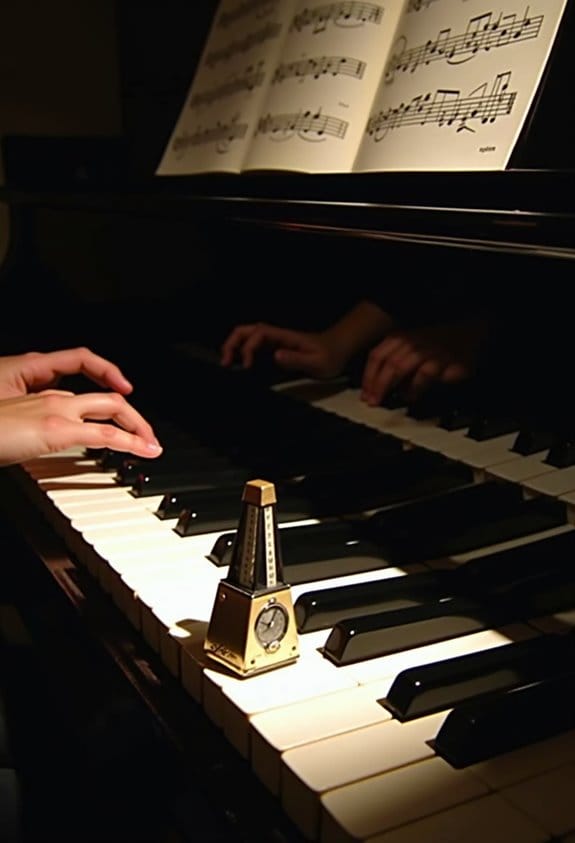
Scales are such a cool starting point when you jump into playing the piano! They form the foundation of music, helping you create beautiful melodies and harmonies. Think of scales as the ABCs of piano—once you know them, everything else gets easier.
Have you heard about major and minor scales? Major scales have this bright, cheerful sound, while minor scales bring a more moody vibe. It’s kind of like having different colors of emotions in your music!
By practicing scales, you’ll not only improve your finger agility—transforming those clumsy moves into graceful ones—but you’ll also start spotting patterns in music pieces. For example, when you play a C major scale, you might notice that many songs you enjoy use those same notes. Plus, every major scale has a corresponding minor scale; for instance, the A minor scale is the relative minor of C major. Understanding the Circle of Fifths can help you transition between these scales smoothly, making your playing even more versatile.
For an enhanced playing experience, using a piano damper pedal with features like a polarity switch can improve performance and versatility.
Understanding Chords and Their Connections
Hey there! So, let’s talk about chords and how they bring a song to life. Chords are basically groups of notes played together, and they add a unique flavor to music depending on how the notes are arranged. Think of a major chord as bright and cheerful, like a sunny day, while a minor chord feels more mysterious, almost like a shadowy evening.
Now, to really create compelling music, you’ll want to understand chord progressions. These are patterns that musicians often use—like the classic I-IV-V progression. This particular sequence gives many popular songs their catchy appeal, whether you’re jamming out to rock songs or soft ballads.
Another handy tool in your musical toolkit is the Circle of Fifths. It shows you how different keys are related, making it easier to transition smoothly between them. For example, if you’re in the key of C major and want to move to G major, the Circle helps you understand that connection.
And don’t overlook chord inversions! They simply rearrange the notes in a chord, adding some variety to your sound, much like switching the arrangement of furniture in a room can change the vibe. So, as you explore the world of chords, think of it as an exciting journey; you’re gathering all the skills needed to create your musical masterpiece! The choice of instrument materials, such as bass guitar body woods, can also influence the tonal qualities of your music, highlighting the importance of wood type in shaping sound. What should we explore next in this musical adventure?
Intervals: The Building Blocks of Melody
Hey there! You know how melody really brings music to life? Well, intervals are like the secret ingredients that help create those catchy tunes we can’t get out of our heads! An interval is basically the distance between two notes, and it’s super important for shaping how a melody feels. Think about your favorite happy song—those upbeat jumps make you want to dance, while a slow, melancholic track with smaller steps might tug at your heartstrings.
There are different types of intervals, like major, minor, perfect, augmented, and diminished. Each one has its own unique vibe. For instance, a major interval often feels bright and cheerful, while a minor interval can sound more somber or reflective. You can hear the difference in songs like “Happy” by Pharrell, which features a lot of major intervals, versus “Someone Like You” by Adele, which relies more on minor intervals for its emotional impact.
When it comes to connecting notes, small gaps or conjunct intervals create a smooth flow, making melodies easy to sing along with. In contrast, larger jumps or disjunct intervals inject some excitement and surprise! Picture that exhilarating leap in the chorus of “Jump” by Van Halen—it really makes you want to move. Just like a guitar’s tone can be enhanced by a compensated saddle that improves intonation across the fretboard, refining intervals helps musicians craft melodies with precise emotional expression.
Harmony: The Foundation of Musical Expression
You know what really brings music to life? It’s harmony! When different notes come together, they create this incredible depth that transforms a simple melody into something emotionally powerful. Just think about how even a slight change in notes can completely shift the vibe of a song.
Chords are the core of harmony. They can be major, giving off a bright and happy feel, or minor, which often sound more sad or introspective. For example, a C major chord feels joyful, while its counterpart, A minor, brings a touch of melancholy. It’s amazing how just swapping one chord for another can stir entirely different emotions in us.
Now, let’s talk about chord progressions. These are like the musical pathways that guide us through the emotional journey of a piece. Often, musicians use Roman numerals to map out these paths, allowing them to easily communicate which chords to play. For instance, a common progression like I-IV-V (C-F-G) carries a sense of movement and resolution.
When you start mastering harmony on the piano, you don’t just support melodies; you also unlock your creativity in improvisation! Understanding how chords relate to one another opens up a whole new world. Are you ready to explore more about how harmony shapes the music we love? It’s also important to consider factors like polyphony in digital pianos, which affect how richly these harmonic textures can be expressed.
Key Signatures and Their Impact on Performance
Think of key signatures as a map for navigating a familiar neighborhood. They show you which notes to play sharp or flat, helping to shape the music’s overall vibe. Plus, they give you a solid clue about major scales and their related minor scales. Isn’t that neat?
When you truly get to grips with these signatures, you can spot patterns in scales and chord progressions easily. For example, if you see a key signature with two sharps, like D major, you can immediately understand it leads you to a specific set of notes and chords. This knowledge makes shifts in your performance feel natural and seamless.
Also, by mastering key signatures, you’ll see a boost in your sight-reading skills. You won’t have to pause or scratch your head over tricky notes anymore. Instead, you can confidently tackle sheet music and keep the music flowing. So, the next time you glimpse a key signature, think of it as a helpful map guiding your musical journey!
Understanding key weight adjustments can also enhance your playing comfort and technique, as consistent key response complements your musical interpretation.
Enhancing Improvisation Skills Through Theory
Improvisation on the piano can feel like embarking on an exciting adventure, and understanding music theory acts as your trusty guide through this journey. When you know your chord progressions, you can whip up melodies on the spot without missing a beat. For example, if you’re familiar with how the I-IV-V progression works, you can easily shift between chords while letting your creativity shine.
Exploring modes like the pentatonic and blues scales also opens up a whole new world of expression. Think about it: when you jam, being able to move around in these scales can help you fit in whether you’re playing rock, jazz, or even pop music. You could pick a simple pentatonic scale and create a catchy tune right away, regardless of the genre!
Now, when it comes to practicing structures like the 12-bar blues, it’s similar to setting up a trampoline. You get a solid rhythm as your base, and then you spring off into your own unique ideas. It’s a great way to balance familiarity with spontaneity, giving you something to bounce back to when you’re improvising.
Recognizing patterns in music theory can also help you understand how notes relate to each other, making it easier to craft those spontaneous melodies. And when you want to switch things up, using the Circle of Fifths is a fantastic tool—it’s kind of like having a map to lead you to different musical key areas.
Practical Applications of Music Theory for Pianists
Hey there! You know, music theory is really like a secret toolbox for us pianists. It has all the tools you need to make playing the piano not just easier, but way more enjoyable! When you get the hang of music theory, you start to see how chords work together, which means you’ll be able to play songs by ear. Imagine how cool it would be to pick up a tune you love and just play it without sheet music!
Let’s talk about scales for a second. When you master your major and minor scales, it actually helps with your finger agility and makes those tricky passages feel like a breeze. And then there are intervals, which are super important for crafting those beautiful melodies that really connect with listeners. For example, if you know what a perfect fourth sounds like, you can easily create some unforgettable hooks!
Understanding key and time signatures is another biggie. It makes reading sheet music a lot less daunting and helps you learn pieces faster. Plus, with this knowledge, you can confidently transpose songs to different keys or improvise on the spot. Imagine taking a simple melody and giving it your own twist! So, as you can see, having a grasp of music theory can truly elevate your piano playing. Ready to explore more techniques and enrich your musical journey? Many pianists also benefit from understanding acoustic guitar cutaway designs to broaden their musicality and appreciate sound structures in different instruments.
Frequently Asked Questions
How Does Music Theory Improve Sight-Reading Skills for Pianists?
Q: How does music theory improve note recognition for pianists?
A: Music theory helps pianists understand the relationships between notes, scales, and chords, which enhances their ability to identify these elements quickly on the page. This improved recognition leads to faster sight-reading. Tip: Practice identifying intervals and chords on a staff to build your note recognition skills.
Q: What role do rhythmic patterns play in sight-reading?
A: Understanding music theory allows pianists to identify and anticipate rhythmic patterns, which is crucial for accurate timing and flow in performance. Recognizing these patterns enables musicians to maintain a steady tempo while sight-reading. Caveat: Be mindful that complex rhythms can still pose a challenge, so practice clapping or counting rhythms before playing them.
Q: How can effective sight-reading techniques be applied using music theory?
A: Music theory equips pianists with strategies such as chunking (breaking down music into manageable sections) and recognizing common motifs, making sight-reading more efficient. These techniques help pianists predict musical trends and navigate scores smoothly. Tip: Regularly practice sight-reading different pieces while applying these techniques for better results.
Q: What is the overall benefit of music theory for sight-reading skills in pianists?
A: By integrating music theory into their practice, pianists can achieve greater speed and precision in reading music, ultimately enhancing their overall performance. The deeper understanding of the music allows for quicker assimilation of new pieces. Caveat: Remember that consistent practice is key, as theory alone cannot replace the importance of playing regularly.
What Are Some Common Mistakes Beginners Make in Music Theory?
Q: What common mistakes do beginners make with musical notation?
A: Beginners often make notation errors, which can lead to misinterpretation of musical symbols. This can cause confusion in reading and playing music.
*Tip: Always double-check your notation and practice reading both treble and bass clefs to build confidence.*
Q: How do beginners misunderstand musical intervals?
A: Many beginners misjudge intervals, resulting in unexpected note choices that can disrupt their compositions. This misunderstanding can affect their ear training and melody creation.
*Tip: Practice identifying intervals by ear, using apps or tools that provide interval recognition exercises.*
Q: What are some issues with chords that beginners face?
A: Chord confusion is common among beginners, leading to incorrect harmonization that can diminish the overall quality of their music. Understanding chord structure is vital for effective playing and songwriting.
*Tip: Start by mastering basic triads and gradually work on seventh chords to strengthen your harmonic knowledge.*
Can Music Theory Help With Composing Original Piano Pieces?
Q: Can music theory aid in composing original piano pieces?
A: Yes, music theory can be a vital tool in creating original compositions. It provides insights into melodic structure, harmonic progressions, and rhythmic patterns, helping composers craft engaging pieces that connect with listeners.
*Tip: Start by analyzing your favorite compositions to see how theory is applied before experimenting with your own ideas.*
Q: How does understanding melodic structure benefit composers?
A: Knowing melodic structure helps composers create memorable and expressive melodies. A well-constructed melody can evoke emotions and maintain listener interest throughout a piece.
*Caveat: Avoid overcomplicating your melodies; sometimes simplicity is key to memorable music.*
Q: What role do harmonic progressions play in composition?
A: Harmonic progressions form the backbone of musical pieces, providing a framework that supports the melody. Understanding common progressions can inspire creativity and enhance the emotional impact of a composition.
*Tip: Experiment with unconventional progressions to create unique soundscapes for your pieces.*
Q: Why are rhythmic patterns important for original compositions?
A: Rhythmic patterns add energy and movement to music, influencing how a piece is perceived. A strong rhythm can drive the piece forward and captivate an audience.
*Caveat: Be mindful of complexity; overly intricate rhythms can distract from the overall feel of the composition.*
How Do Different Music Genres Utilize Theory in Piano Playing?
Q: How does jazz utilize theory in piano playing?
A: Jazz improvisation emphasizes spontaneity, allowing musicians to create in the moment while adhering to specific harmonic frameworks. This genre often uses extended chords and complex rhythms, which can lead to rich, expressive performances.
*Tip: Practice playing scales and arpeggios over various chord changes to enhance your improvisation skills.*
Q: What are the key features of classical piano theory?
A: Classical music focuses on structured forms and harmony, placing importance on composed works and predefined progressions. Musicians are trained to understand counterpoint and voice leading, which contribute to the overall musical narrative.
*Tip: Analyze classical pieces to see how composers build their themes and variations.*
Q: How does rock music approach piano theory?
A: In rock, rhythms are prioritized, with a strong emphasis on the backbeat to drive the music. While harmony is still important, rock often simplifies chord progressions, allowing for catchy melodies and riffs.
*Tip: Experiment with percussive playing techniques to highlight the rhythm in your rock piano performance.*
What Practice Techniques Reinforce the Connection Between Piano and Music Theory?
Q: What are effective practice techniques that reinforce the connection between piano and music theory?
A: Engaging in chord progressions helps pianists understand harmonic relationships and enhance their improvisation skills. A practical tip is to practice common chord progressions like I-IV-V-I in various keys to solidify your knowledge.
Q: How can scale exercises contribute to mastering piano and music theory?
A: Performing scale exercises improves finger dexterity and reinforces the theoretical concept of key signatures and scales. A caveat is to focus on both major and minor scales, as this will prepare you for a wider range of musical pieces.
Q: Why is developing interval recognition important for pianists?
A: Developing interval recognition skills allows musicians to understand distances between notes, which is essential for sight-reading and ear training. A practical tip is to use flashcards or apps to quiz yourself on different intervals to reinforce your learning.