As an Amazon Associate, we earn from qualifying purchases. Some links on this site are affiliate links at no extra cost to you. Our recommendations are based on thorough research and editorial judgment.


Understanding Major and Minor Keys on the Keyboard

Unlocking the world of major and minor keys on the keyboard is akin to unveiling the emotional palette of music!
You may be interested


If you’re a budding musician or an enthusiastic music lover, get ready to discover how these essential chords can transform your sound.
Major chords radiate happiness, serving as your musical “ray of sunshine,” while minor chords introduce a more contemplative, occasionally melancholic tone that can change the entire feel of a song.
In this journey, you’ll learn how to identify related chords and embark on a fun exploration of songs that beautifully showcase these enchanting sounds.
Let’s dive in and elevate your musical expression!
Key Takeaways
- Major keys produce a bright and uplifting sound, while minor keys evoke a melancholic and introspective vibe on the keyboard.
- Major chords consist of the root, major third, and fifth, while minor chords have the root, minor third, and fifth.
- Relative minors can be found by counting three half steps up from the major key, facilitating smooth transitions between moods.
- Familiarity with key signatures helps musicians understand emotional dynamics and enhances their compositions on the keyboard.
- Regular practice of major and minor scales improves finger technique and musical expression when playing on the keyboard.
Major Chords

Hey there! Have you ever noticed how major chords in music are like rays of sunshine breaking through a cloudy day? They really do bring a sense of brightness and positivity to any song! Major chords come from major scales and are made up of three sweet notes: the root, major third, and fifth. For instance, take a C major chord—it’s made up of C, E, and G.
Now, let’s talk about that major third. The distance from the root note to the major third is four half steps—think of it as a little musical jump! Because of this cheerful sound, major chords play a vital role in many chord progressions, like those you’d hear in pop hits or feel-good anthems.
Getting a handle on major chords can really elevate your music skills. They create a strong and uplifting vibe in your compositions. Plus, when you play them in different inversions, you add a nice twist to your sound! So, give it a shot; experiment with C major, then try an A major! You might just find your next favorite chord progression. Ready to explore more musical ideas? Let’s keep this creative energy going! 🎶 Additionally, just like how an accordion strap must offer adjustable lengths for comfort, musicians can also benefit from adapting their chord choices to fit the mood and style of their music.
Recommended Products


Looking for the ultimate piano cheat sheet that'll make you the talk of the town? Look no further, because we've got just the thing for you! Introducing the awesomely unique Ultimate Piano Reference Poster that packs a powerful punch for all piano players, teachers, and songwriters alike.
Minor Chords

Hey there! Let’s chat about minor chords. Think of it this way: to create a minor chord, you start with a major chord and simply lower the third note by one key. So, in a C minor triad, you’d play C, E♭, and G. It’s like taking a sunny day and flipping it to something a bit moodier—pretty neat, right?
When you’re playing C to E♭, you’re hopping over two keys, and then from E♭ to G, you’re skipping three. This shift really gives minor chords that rich, melancholic vibe that can tug at your heartstrings. Have you ever noticed how many love songs or sad ballads use minor chords? They can convey feelings of longing or heartache, which makes them super important in music.
Getting comfortable with minor chords and their key signatures helps you tap into those emotions when you play. Next time you’re jamming, try tossing in a few minor chords, and see how they change the mood of your music—it’s a great way to express more complex feelings! Using tone enhancers like EQ controls can also elevate the emotional impact of your minor chords when played through an acoustic guitar preamp.
Recommended Products
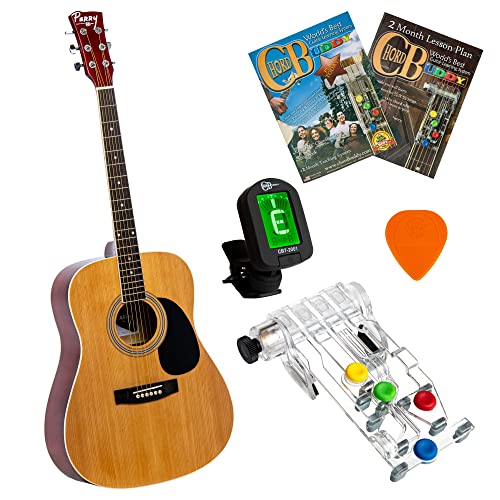
GUITAR PRACTICE PACK: Play the guitar the same day you get it with ChordBuddy, the easiest guitar learning system for all ages. As seen on Shark Tank, ChordBuddy makes mastering guitar chords simple.

One California Debut Redondo acoustic guitar, one gig bag, one guitar stand, one strap, picks, one clip-on tuner and extra strings

【MOST COMPLETE BEGINNER GUITAR PACKAGE】: Donner acoustic guitar kit includes 36 inch acoustic guitar, padded gig bag, strap, digital clip-on tuner, capo, pickguard, extra pack of steel strings, 4 celluloid picks and clean cloth. Comes with most necessary accessories beginners need. A cost-effective guitar set saves time on buying accessories additionally
Sound Characteristics of Major and Minor Chords

Have you ever noticed how major and minor chords sound completely different? It’s pretty amazing how these simple combinations of notes can stir up emotions in us! Major chords, which consist of a root, a major third, and a perfect fifth, have this bright and cheerful tone. Think about how happy songs like “Don’t Stop Believin’” by Journey feel—that’s the power of major chords!
On the flip side, minor chords take us in a different direction. With a root, minor third, and perfect fifth, they introduce a more melancholic and introspective vibe. For example, the haunting sound in songs like “Someone Like You” by Adele showcases how minor chords can evoke feelings of sadness or longing. Isn’t it interesting how just changing one note can alter the entire mood of the music?
The major third gives off a feeling of harmony and satisfaction, while the minor third often feels a bit more dissonant. Plus, cultural influences can change how we perceive these emotions too—what might sound uplifting to one person could feel touching or even sad to another. Overall, it’s a fascinating glimpse into the emotional world of music! Playing these chords on an 88-key weighted keyboard can greatly enhance the authenticity of the sound and emotional expression.
Recommended Products

Bundle Includes: Nord Stage 4 88 88-Key Fully-Weighted Keyboard, Nord Soft Case for Stage EX 88 Piano, Adjustable-Height Z-Style Keyboard Stand, and 88-Key Keyboard Stretchy Spandex Dust Cover (Black)

The Piano: The Nord Stage 4 comes with a new enhanced collection of Grands, Uprights and Electric Pianos from our exclusive Nord Piano Library combined with new features such as Dynamic compression and Unison.

FULL 88-KEY HAMMER ACTION RANGE (A–C): Triple sensor weighted keybed delivers authentic grand piano feel with precise dynamic response for expressive live performance and studio use
Examples of Songs Featuring Major Chords
You know, major chords aren’t just a bunch of notes thrown together—they really pack a punch in making songs memorable! Think about classics like Mozart’s “Eine kleine Nachtmusik” or John Lennon’s uplifting “Imagine.” Both of these pieces have that bright, cheerful sound that can lift your spirits instantly!
Take Robbie Williams’ “Angels,” for example. The melodies there are filled with hope, resonating with listeners and making them feel all sorts of warm and fuzzy. Ever wonder why some songs just hit you in the feels? It often boils down to the use of major chords, which create a sense of stability and celebrate those joyful moments in life. Just like how a 0.022uF capacitor maintains brightness in guitar tones, major chords maintain that bright, uplifting quality in music.
Examples of Songs Featuring Minor Chords
You know what’s really cool about music? Many unforgettable songs today use minor chords to tap into some pretty profound emotions! Those minor chords often bring out feelings of sadness or nostalgia, which can make a piece of music really resonate with listeners. A classic example would be Beethoven’s “Moonlight Sonata.” Its minor chords create this hauntingly beautiful vibe, drawing you into a kind of dreamlike state.
Take “Skinny Love” by Birdy. The minor chords in this song perfectly capture that aching sense of longing and heartache. It’s amazing how something as simple as a variation in scale can express such deep feelings, don’t you think? John Legend also does this beautifully in “All of Me,” where the minor chords help illustrate vulnerability in romance.
And let’s not forget Leonard Cohen’s iconic “Hallelujah.” He cleverly switches between major and minor chords, layering the song with complex emotions. When you understand how these minor chords work, it’s easier to appreciate why certain songs stick with us. After all, that emotional connection is what makes music so powerful. What’s your favorite song that evokes similar feelings? Exploring different slide sizes and materials, like borosilicate glass guitar slides, can also enhance the emotional expression in your playing.
Understanding Relative Major and Minor
Hey there! Let’s chat about the fascinating world of music theory, particularly the relationship between relative major and minor keys. It might sound a bit complex at first, but once you get the hang of it, it’s super fun! For example, if you look at C major, its relative minor is A minor, and you can find it by simply counting three half steps down on the piano. Easy peasy, right?
This concept works for all twelve major keys! So, if you’re in G major, just go down three keys, and you’ll find E minor. Understanding these relative keys opens up a whole new way to explore chord relationships in your music. By mastering this connection, you can effortlessly switch between major and minor scales, making your playing more dynamic. Just like maintaining your piano’s condition with piano hammer replacements ensures optimal sound, understanding key relationships helps maintain musical harmony.
Recommended Products


2-in-1 Fretboard Mastery Bundle – Includes the Sliding Guitar Chord Compass & Scales Compass, plus two in-depth decoder books. Perfect for learning the CAGED system, scales, triads, and chord construction.

Finding Relative Major and Minor Chords
Hey friend! Let’s chat about how to find relative major and minor chords—it’s actually pretty neat once you get the hang of it! To find the relative minor of a major chord, just count three half steps down from the root note. For example, if we take C major, when you move down three half steps, you end up on A minor. It’s like a little musical shortcut!
Now, if you flip that around and start with a minor chord, you can find its relative major by counting three half steps up. Take F minor, for instance. If you go up three half steps, you land on A♭ major. Pretty straightforward, right?
This method creates a clear connection between chords, making it easier to explore different musical keys. Once you grasp this concept, you’ll feel more confident in your chord progressions and can start experimenting more freely!
Understanding chord relationships is similar to how scalloped bracing enhances the resonance and tonal range of acoustic guitars for richer sound.
The Importance of Music Theory for Pianists
Hey there! You know, music theory is really like a secret code that can totally enhance your skills as a pianist. When you grasp this code, you’ll start to see how major and minor scales work. For example, if you remember the patterns W, W, H for major scales (that’s whole, whole, half steps) and W, H, W for minor scales, you can easily create chords and melodies that sound great.
But there’s even more to it! Understanding key signatures can help you figure out the mood of a piece. Is it bright and cheerful in a major key, or is it more somber in a minor key? This knowledge can shape how you express yourself through your playing. Plus, when you know the relationships between chords, you can shift keys smoothly and even throw in some improvisation when you’re feeling creative.
For musicians learning to translate theory into practice, considering the compatibility of different components—like how guitar pickups are mounted—is equally essential for a seamless setup.
Exploring Additional Learning Resources
You know, exploring new music resources can feel a lot like going on a treasure hunt! If you’re learning about major and minor keys, I’ve got a great tip for you: check out the Flowkey app. It has an awesome library of chords, making it super easy to practice both major and minor chords. Plus, practicing scales can be fun with free lessons tailored for different learning styles, which is a huge help!
Joining communities like Musical U can really enhance your experience. They offer guides and podcasts that keep things entertaining. And if you enjoy listening, try out some videos from Classical MPR. They do a fantastic job of showcasing the emotional differences between major and minor keys through actual music – you can really hear how they feel different.
Oh, and have you ever wanted to play some familiar songs? There’s a curated list of 20 easy piano songs that can help you grasp those key concepts while having fun. Each piece you master is just like adding another gem to your musical treasure chest! Speaking of gems, let’s talk about effective practice routines next. Many excellent beginner books use clear step-by-step lessons that can guide your skill progression smoothly.
Recommended Products


Practical Applications of Major and Minor Keys
Hey there! Let’s chat about the practical applications of major and minor keys in music. You know how major keys have that upbeat, happy vibe—just think of feel-good tunes like “Happy” by Pharrell Williams. On the flip side, minor keys can bring out a more serious or reflective mood, similar to the haunting melodies in “Someone Like You” by Adele.
Did you realize that A minor is actually the relative minor of C major? This relationship is super handy when you want to transition between the bright energy of C major and the deeper emotions of A minor in your songs. It’s like having a key that opens different doors in your music.
To really nail this down, try practicing your major and minor scales regularly. Not only does it improve your finger technique, but it also gives you a solid foundation for playing and writing. Plus, when you get comfortable with chord progressions, you can create pieces that resonate emotionally with your listeners. So, go ahead and experiment with these keys on your keyboard, and see what kind of magic you can create. You might just stumble upon your next favorite song!
Additionally, much like upgrading an instrument with a bone saddle can enhance tonal clarity and richness, understanding key choices can enrich the emotional texture of your music.
Frequently Asked Questions
How Do You Understand Major and Minor Keys?
Q: What are major and minor keys?
A: Major and minor keys are musical constructs characterized by specific key signatures. Major keys generally consist of a series of whole and half steps that create a bright sound, while minor keys produce a more somber tone through a different arrangement of intervals. Tip: Familiarizing yourself with the piano keyboard can help visualize these keys.
Q: How do major and minor keys convey emotions?
A: Major keys typically evoke feelings of happiness and joy, while minor keys often express sadness or melancholy. This emotional difference stems from the unique interval structures in each scale. Caveat: Individual experiences with music can affect emotional responses, so personal interpretations may vary.
Q: What role do chord progressions play in major and minor keys?
A: Chord progressions in major and minor keys follow established patterns that enhance their respective emotional qualities. Major progressions often include chords that produce uplifting sounds, whereas minor progressions may utilize more complex or dissonant chords for depth. Tip: Listening to popular songs in different keys can help improve your understanding of these progressions.
Q: How can I recognize major and minor keys?
A: Recognizing major and minor keys involves identifying their key signatures and listening for the emotional tone of the music. Major keys have a bright, happy sound, while minor keys tend to be darker and more introspective. Caveat: The context of a piece can sometimes blur these distinctions; always consider the full sound.
How Do You Find the Minor Key if You Know the Major Key?
Q: How do you find the relative minor key from a major key?
A: To find the relative minor key, count down three half steps from the tonic note of the major key. Alternatively, you can ascend to the sixth degree of the major scale to identify the minor key.
*Tip: Remember that the relative minor shares the same key signature as the major key, which can help in identifying them quickly.*
Q: What is the emotional impact of major and minor keys?
A: Major keys often convey a happy or bright emotional quality, while minor keys tend to evoke sadness or introspection. This difference in emotional context influences how the chords are used in composition.
*Caveat: The emotional impact can vary based on context, tempo, and arrangement, so be open to exploring different feelings within the same key.*
Is a C Major the Same as a Minor?
Q: Are C Major and C Minor the same?
A: No, C Major and C Minor are distinct scales. C Major is known for its bright, stable sound, while C Minor conveys a more melancholic and dissonant tone.
Tip: When composing, consider the emotional impact you want to achieve: use Major for uplifting themes and Minor for more somber feelings.
Q: What does C Major represent musically?
A: C Major symbolizes joy and stability in music. Its chords and melody often create a sense of resolution and happiness.
Tip: Experiment with chord progressions in C Major to evoke positive emotions in your compositions.
Q: What emotions does C Minor evoke?
A: C Minor typically conveys feelings of sadness and tension. It is often used in music to express a more introspective or dramatic tone.
Tip: Use C Minor in your music to explore deeper emotional narratives, but be mindful of balancing its darker tones with lighter melodies.
What Are the 7 Major Keys in Music?
Q: What are the seven major keys in music?
A: The seven major keys are C, G, D, A, E, B, and F. Each key has its unique characteristics and is used for different emotional expressions in music.
Tip: Familiarize yourself with the key signatures of each major key, as this can help you learn and compose music more effectively.
Q: How do the major keys differ?
A: Each major key has distinct tonalities and moods. For example, C major is often associated with simplicity and clarity, while D major tends to evoke a brighter, more celebratory feeling.
Caveat: While each key has its emotional connotations, personal interpretation can vary widely among musicians and listeners.
Q: What historical examples illustrate the use of major keys?
A: Major keys have been employed in numerous classical and contemporary pieces throughout music history. For instance, Beethoven often utilized C major in his symphonies to convey triumph.
Tip: Listening to a variety of pieces in each major key can enhance your understanding of their emotional impact and technical styles.


